My Husband's Story
There are less than 1,000 people with GATA2 Deficiency Syndrome. Most die within 5 years of diagnosis. The only known cure is a stem cell transplant.
BOM's Story

Late last September (or early October, not entirely sure exactly what day it happened), my husband (BOM) stepped on something. Right before Thanksgiving, his foot still hadn't healed and looked kind of awful, so he went to the doctor. They ran blood work to ensure he didn't have an infection.
Within minutes of receiving the results, they were calling, telling him to go to the ER for more testing that their lab couldn't handle. From there, he was sent straight to HEM/OC for more tests because his bloodwork was so bad.
His local HEM/OC ran every test under the sun, and around the beginning of this year, he learned that he has GATA2 Deficiency Syndrome. His care was referred to the transplant team at UAMS, then to MD Anderson, and subsequently to NIH.
Because there are fewer than 1,000 people with GATA2, and he is 1 of 5 with his specific variant, very few hospitals have ever dealt with the condition before.
Without going into a whole genetics lesson… Essentially, a gene in his body has mutated, causing it to change one amino acid necessary for blood cell production into a different type of amino acid, leaving his bone marrow unable to produce what's needed to keep his immune system functioning.
His gene mutation occurred in a location that has only been seen four other times before, and those individuals are still asymptomatic. So everything they learn about his variant now is important. It may save lives in the future. And for a condition where half of patients don't survive to his current age, that's critical.
In addition to immunodeficiency, GATA2 causes profound hearing loss, lupus, severe (often fatal) fungal infections, pulmonary alveolar proteinosis, and a myriad of other serious and life-threatening issues. Entire family groups can be impacted.
Without a stem cell transplant, it progresses to acute leukemia in about 80% of cases. The mortality rate is astronomical, with most patients dying within five years of diagnosis.
The only cure is a donor stem cell transplant.
He's currently waiting for some final DNA results to come back so NIH can clear him for a transplant. If he's cleared, we'll be relocating closer to NIH for 6 to 9 months for the transplant. If he isn't, we don't know what comes next for him.
But his bone marrow is rapidly failing, meaning it isn't making enough of any type of blood cell. As a result, he has virtually no immune system (his absolute neutrophil count is currently 100; it should be over 1500 at a minimum).
He falls a lot. He's dizzy all the time. He's weak. He sleeps a LOT. He takes a handful of prescriptions twice a day to try to keep himself healthy for as long as possible. He isn't allowed to go out or have people over because even a simple cold could be catastrophic. His liver and spleen are enlarged. His kidneys are atrophic.
His care team consists of over a dozen doctors, researchers, and specialists spread across four different hospitals in three different states, all working together to learn what they can about this variant and how to tackle it.
We've spent a lot of time over the last year explaining his condition to local doctors, to insurance companies, and to family and friends. Aside from oncologists, most doctors simply aren't aware of it because they've never seen it before.
A year ago, we knew nothing about GATA2 either. One year and hundreds of blood, bone marrow, and medical tests later (literally, hundreds), we're in the unfortunate position of knowing more than we ever wanted to know. So I wanted to share a little bit of his journey today to bring awareness to the condition. Because it's a rare disease, this may be the only time you hear of it.
I sincerely hope it is. GATA2 is rare and life-threatening, but it isn't the only rare, life-threatening illness out there. There are over 7,000 known diseases like his, and 1 in 10 people in the United States will be diagnosed with a rare disease in their lifetime.
You can help make treatment possible for BOM and patients like him. Sign up to be added to the Bone Marrow Donor Registry here.
And if you aren't already an organ donor, you can sign up as an Organ Donor here.
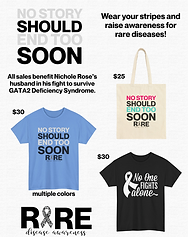
And if you'd like to support BOM in other ways as he fights for his life, members of the romance community have put together a fundraiser here. You can also buy t-shirts here.
Thank you for your continued prayers and the outpouring of love and support you've sent to him (and to me) over the last year. We appreciate each and every one of you more than you know.